According to new data submitted by Foodlink’s network, local requests for food assistance are hitting all-time highs.
Each month, local food pantries and meal programs within Foodlink’s membership network record the number of people who visit and ask for help. They tabulate the number of adults, seniors and children served, and submit those statistics to Foodlink each month.
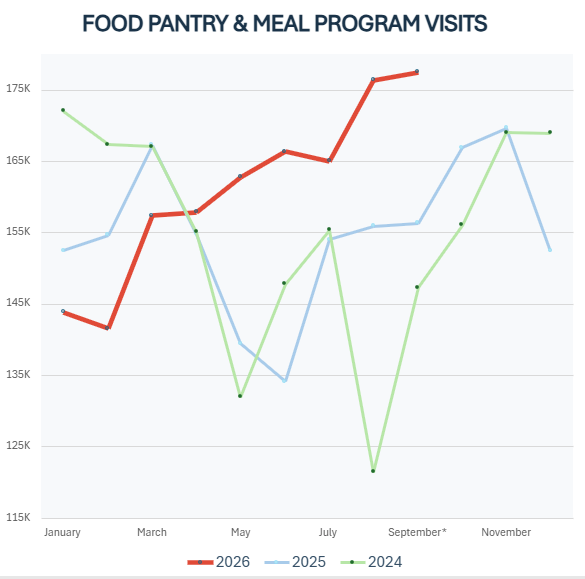
Data submitted to Foodlink for August and September represented the two highest months of client visits in our recorded history. During both months, there were more than 175,000 visits to local food pantries and meal programs throughout Foodlink’s 10-county service area. The previous high was recorded in January 2024 (172,027). The numbers do not represent unique people — rather the number of times a request for assistance occurred.
DONATE TODAY: Help us meet this surge in demand
“We are seeing a steady increase in the number of individuals and families turning to the pantry for support.” said Anne Ranieri, who leads the Sent by Ravens food pantry in Livonia. “As a completely volunteer-run organization, this increase is placing additional demands on our volunteers, resources, and weekly operations as we work to meet the growing need while continuing to serve our community with dignity and compassion.”
St. Peter’s Kitchen, Foodlink’s busiest meal program that operates Monday through Friday on Brown Street in Rochester, is seeing a 56% increase in people served. They typically serve 400-450 meals over the span of just one hour on weekdays.
A range of factors are contributing to the elevated need, including thousands of local residents losing their SNAP benefits this summer, and the high cost of food and fuel driving prices up for all consumers nationwide.
Another one of Foodlink’s members, the Perinton Food Shelf, held a ribbon-cutting Nov. 5 to celebrate a move into an expanded space, and commented on the rise in need locally. According to 13 WHAM:
Susan DeGregory, the Perinton Food Shelf’s volunteer director, said the demand has increased as families face a tougher economy and changes to assistance programs.
“And now we have, you know high gas prices, high food prices. People are trying to pay their rent — and we are able to help out, and it’s a wonderful thing,” DeGregory said.
Roseann Bruner, Director of Operations, added: “I just think that it’s important that people understand that food insecurity happens at a moment’s notice sometimes, and it can happen to anybody. So, taking care of your neighbors is key because when your neighbors are doing well, the whole community is doing well.”
Check out the chart above for a comparison of the first nine months of this year — which has seen a steady incline for nearly every month since February — compared to the last couple years. As you can see, the previous high mark in January 2024 fell swiftly, then fluctuated up and down throughout the year. The same pattern occurred in 2025. In 2026, however, pantry visits began the year below 150,000/month, but have risen steadily since.
Another food bank member, The People’s Pantry located on Avenue D in Rochester, has seen a steady rise in clients since the summer. After serving 2,684 people in July, they served about 3,000 people in August and September, and according to their latest statistics, served 3,273 in October. “As food insecurity rises, more new clients are seeking our services,” said Executive Director Char Cordone. “Continued support is vital to help pantries meet this growing demand and serve the families who need them.”
Accord Corp., a community-action agency that helps people meet their basic needs in Allegany County, has ramped up its support for seniors by working directly with the county’s Office of the Aging to send food boxes directly to their homes. “Some developing partnerships allowed us to learn more about how older adults access food and where the gaps are,” said Community Operations Director Belinda Knight, who added that their organization is serving about 10 new families every month. “The characteristics of those families include working families, single adults, and homeless individuals and families. Their stories include concerns about food prices and utility costs, which have made it very difficult for families to put food on the table. Families who are unhoused are struggling to find safe affordable housing, so we’re serving several homeless individuals on a weekly basis.”